

ToDos
ToDos are tasks – created by agents, from automations, or by colleagues. They are collected centrally in the “To-Dos” area and show all important tasks at a glance.
What Are ToDos Suited For?
- Receiving and completing tasks from agents, e.g. reviewing a proposal
- Making decisions that a workflow requires, e.g. approving a budget between two options
- Distributing tasks in the team and seeing who is responsible
- Keeping track of deadlines – tasks due today are highlighted in red
The To-Do Overview
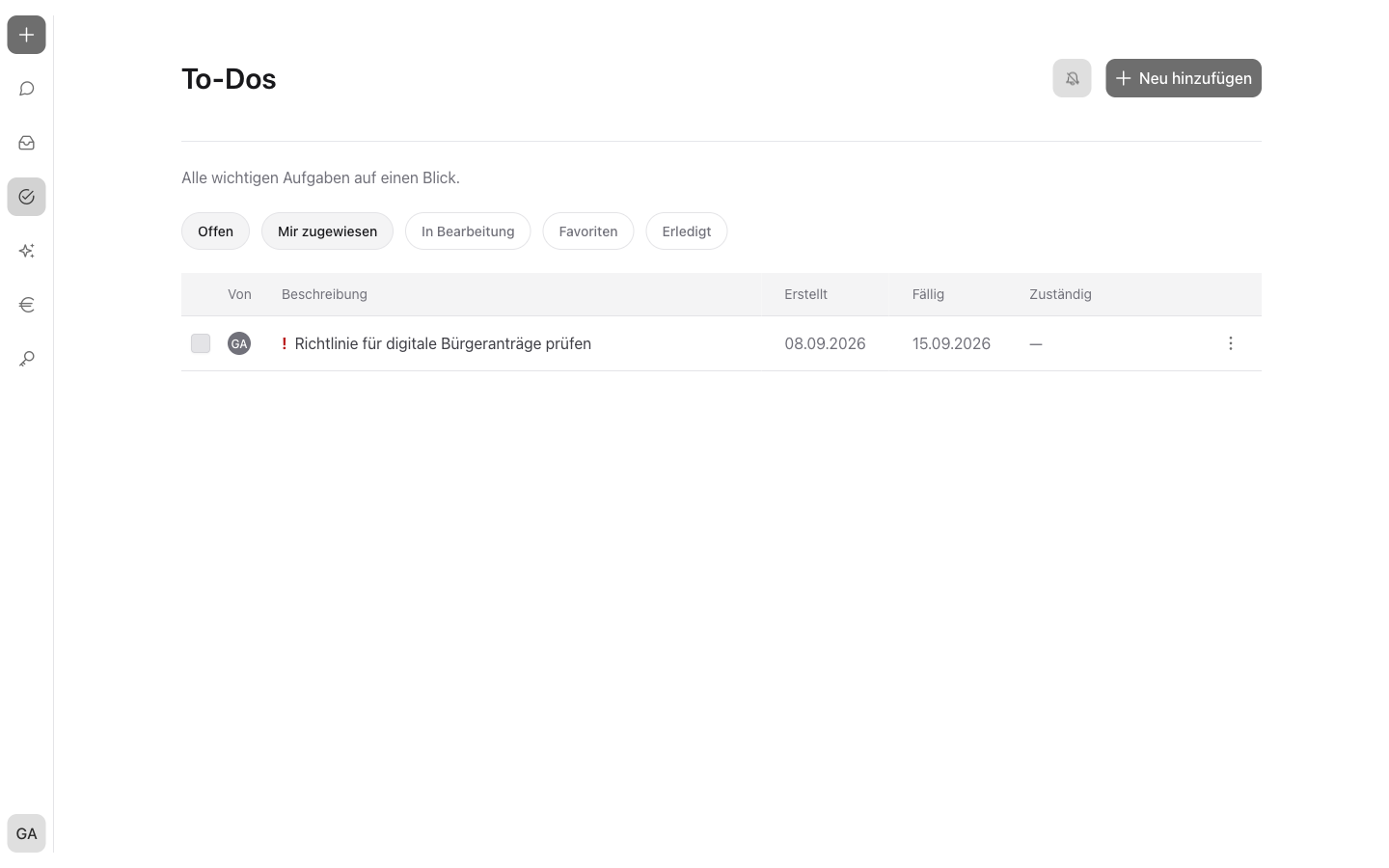
The overview opens via “To-Dos” in the navigation. The number of unread to-dos is shown in the navigation. Two counters at the top of the overview show how many tasks are due today and how many are unread.
Each row shows:
 the completed status (see Working on ToDos)
- the source: initials of the creating person or the agent's symbol – the name appears in the tooltip
- the title, plus
 for unread and
  for important; special to-do types are marked (see Understanding To-Do Types)
 - created date and due date – to-dos due today are highlighted in red – as well as the responsible person
 the three-dot menu with further actions (see Working on ToDos)
The list can be narrowed down via the filters “Open”, “Assigned to me”, “In progress”, “Favorites”, and “Done”; the number of unread to-dos appears on each filter. Via “Mark all as read” , all open to-dos are marked as read at once.
Reading ToDos
A click on a row expands the to-do and shows its full content. The content is formatted and can contain tables, lists, code blocks, and diagrams (see Diagrams in Answers). When expanding, the to-do is automatically marked as read.
Creating a New ToDo
Via “Add new”  , a dialog with the following entries opens:
- Title: required heading of the to-do
- Description: required content; simple formatting is applied when displayed
- Due date: optional deadline
- Mark as important: highlights the to-do with
- ToDo share: define the recipients. Select individual users and groups – or activate the option “Share with all users”, then all users of the company receive the to-do.
At least one person or group must be selected, or “Share with all users” must be activated.
Note
Groups are only available for selection by administrators (see Roles and Permissions).
Note
Created to-dos cannot be edited or deleted later. In case of errors, a new to-do helps.
Working on ToDos
- Take over: Open to-dos are taken over via “Assign to me” in the three-dot menu of the to-do; the to-do then appears under “Assigned to me”.
- Complete: Only the assigned person can change the completed status via . After checking it off, a confirmation appears; the to-do then appears under “Done”.
Warning
Decision to-dos cannot be checked off – they are completed via a decision (see Understanding To-Do Types).
- Release: Via “Remove assignment” in the three-dot menu of the to-do, the own assignment is released; the to-do is open again.
- Watch: Via “Favorite” in the three-dot menu of the to-do, a to-do lands in the favorites – for example, to follow it without being responsible. The “Favorites” filter shows all favorited to-dos.
Understanding To-Do Types
In addition to simple tasks, there are two special types created by agents:
- “Action required” – decision to-do: The to-do requires a decision between two options. When expanded, the decision question appears with two buttons. The decision automatically completes the to-do; the chosen answer remains visible.
- “Waiting for processing” – process to-do: The work delivers a result that the agent needs for the further process. The to-do is worked on in the chat (see Continuing in the Chat). When completed, the chat history automatically goes back to the agent and the workflow continues.
Continuing in the Chat
Via “To chat history” in the three-dot menu of the to-do, the associated chat opens. If the to-do originates from a chat, the button opens that conversation – otherwise, a new chat is started with the agent from which the to-do originates (see Chat). For decision to-dos, the decision can also be made directly in the chat. For to-dos from workflows,  “To orchestrator chat” jumps to the triggering conversation.
Receiving ToDos from Agents
Agents create to-dos on their own. Every agent has the always-active System capability for this, with user search as well as creating information items and to-dos.
- In the chat, the agent can be instructed to create a to-do – with due date, importance, or as a decision. The recipients are named in the chat or selected via @-mention; the agent finds the people via the user search (see Chat).
- Automations create to-dos as part of a workflow – controlled by the workflow orchestrator (see How a Workflow Runs).
Note
incoreon also creates important to-dos automatically – e.g. when a connection to a connected service needs to be renewed.
Setting Up Email Notifications
For every newly assigned to-do, an email with the title can be sent; important to-dos are specially marked in the email. The email notification can be turned on and off in two places:
- via
 in the to-do overview
 - in the profile under “Email notifications” (see Profile)
Warning
Emails are only sent if the notification is activated. The content of the to-do stays in incoreon.
To-Do FAQs
Why can't I check off a to-do?
Only the assigned person can change the completed status. First take it over via “Assign to me” in the three-dot menu of the to-do. Decision to-dos are completed exclusively via a decision.
What does “Action required” mean?
The to-do is a decision with two options. When expanded, the question appears with two buttons; the decision completes the to-do.
What does “Waiting for processing” mean?
The to-do is a process to-do. It is worked on in the chat; when completed, the chat history goes back to the agent and the workflow continues.